Why brand facts get “stuck” in LLM systems
When a product changes, the most frustrating outcome isn’t a missing mention—it’s a confident, outdated one. In practice, “brand facts” (pricing tiers, integrations, feature availability, compliance claims, product names, and positioning) can persist inside retrieval layers and downstream prompts long after you’ve updated your website. That persistence isn’t one bug; it’s a chain of caches.
Most AI answer systems blend three memory surfaces:
- Training memory: older web snapshots and documents baked into model weights.
- Retrieval memory: search indexes and vector stores that fetch “supporting” passages.
- Application memory: your own RAG layer, prompt templates, and response caches.
Cache invalidation for brand facts means designing for controlled forgetting across all three surfaces, then emitting consistent new signals until the old claim stops winning retrieval and citation selection.
The failure modes that keep outdated claims alive
Vector persistence and “near-duplicate” dominance
When you update a doc, the old version may still exist as a chunk in a vector database, or as a highly similar chunk elsewhere (a mirrored help center page, an old PDF, a syndicated post). Because embeddings are similarity-based, near-duplicates compete, and whichever chunk has stronger authority signals, better chunk boundaries, or a more query-aligned phrasing can keep getting retrieved.
This is closely related to embedding collision behavior, where distinct facts compress into similar vector neighborhoods and the retriever can “snap” to the wrong source. If your team has seen inexplicable reversion to an old capability statement, it’s worth treating it as a retrieval quality issue, not just a content issue. For deeper diagnostics, see detecting and fixing vector embedding collisions.
Search index lag and citation inertia
Even if you delete old pages, third-party caches (search snippets, scraped copies, aggregator blogs, and PDF caches) can continue to surface old claims. LLM answer systems that cite sources often overweight “stable” references that appear in multiple places. That creates citation inertia: the model sees the same outdated sentence in many domains, so it becomes the safest-looking thing to cite.
Application-level caches and prompt glue
The simplest cause is also common: your own system caches answers, retrieved passages, or tool results. If the “brand facts” are hard-coded in a system prompt, a “company overview” doc, or a config file, your RAG stack can keep restating the old claim even after your public content has been corrected.
A practical cache invalidation playbook for brand facts
1) Create a canonical “brand facts ledger” with versioning
Before you try to make models forget, make it easy for your own systems to remember correctly. Maintain a single authoritative ledger of brand facts (feature list, pricing, integrations, compliance, positioning statements), with:
- Version number (e.g., Facts v3.2)
- Effective date and deprecation date for prior facts
- Stable IDs for each fact (e.g., INTEGRATION_SLACK=true)
- Short “do not say” list for the most harmful outdated claims

This ledger becomes the source for your website copy, help center, sales enablement docs, and RAG context. If you can’t point to a single fact record, invalidation becomes guesswork.
2) Invalidate at the chunk level, not the page level
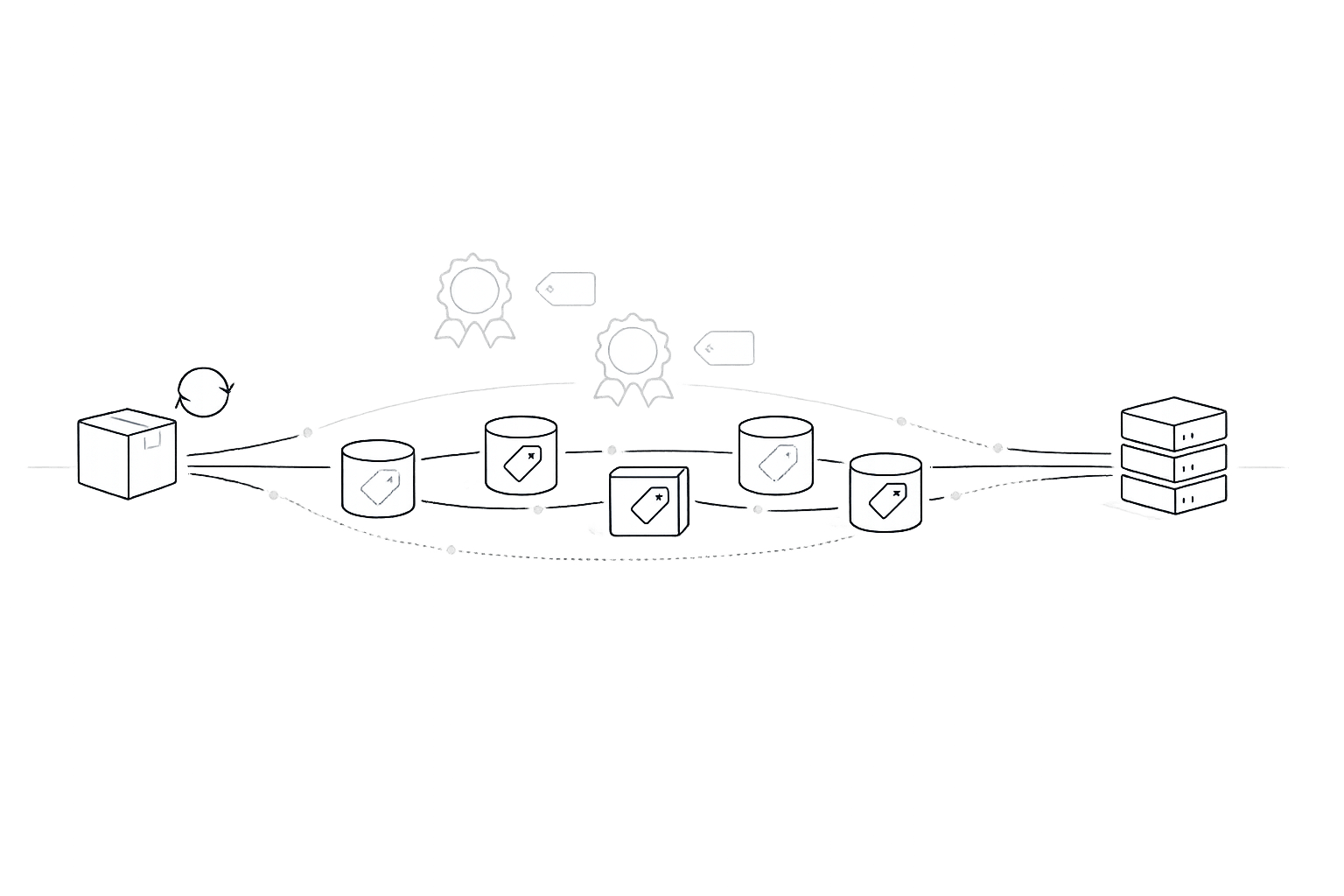
RAG systems don’t retrieve “pages.” They retrieve chunks. When a product update happens, re-indexing only the page URL is not enough if old chunks remain. Use a chunking strategy that supports targeted invalidation:
- Chunk with stable document_id + section_id keys.
- Store a content hash per chunk.
- On update, delete or tombstone chunks whose hash changed, then upsert the new chunk.
- Record supersedes relationships so evaluators can trace replacements.
If your store supports metadata filters, add effective_from and effective_to fields. Then, at query time, filter out expired chunks even if they still exist for audit purposes.
3) Add “fact freshness” into retrieval scoring
Similarity alone will keep pulling the old phrasing if it matches common queries. Introduce a freshness prior:
- Recency boost: newer chunks get a small score lift.
- Authority boost: canonical domains and owned assets outrank mirrors.
- Conflict penalty: if two chunks disagree on the same fact ID, prefer the higher version.
This is not theoretical. Without freshness signals, the retriever has no reason to prefer “2026 pricing” over “2024 pricing” if both match the query equally well.
4) Force contradiction handling in the answer layer
Even with better retrieval, you need a deterministic rule for disagreements. Add a small “conflict resolver” step:
- Extract candidate fact statements from retrieved passages.
- Map them to your fact IDs where possible.
- If conflicts exist, select the newest effective version and cite only sources aligned with it.
- If confidence is low, answer with uncertainty and suggest verification steps.
This is the difference between a system that sometimes answers correctly and a system that is designed to stay correct through changes.
5) Reduce external persistence by publishing clean replacements
“Forgetting” in public AI systems is often about outcompeting old signals. When a product update ships, publish replacements that are:
- Explicitly current: include the current year or release name where appropriate.
- Schema-rich: FAQ schema, product schema, and clear headings that match common queries.
- Consistent across formats: docs, changelog, blog post, short video scripts, and social snippets should use the same phrasing for the changed fact.
One practical approach is to run an always-on publishing stream that creates repeated, consistent, multi-source signals so that assistants see the updated fact in more than one place. That’s the category of “AI visibility infrastructure” that xale.ai focuses on: generating brand-grade content and distributing it across many independent surfaces with structured metadata so updated claims become the dominant retrievable pattern over time.
6) Measure “forgetting” with citation determinism tests
You can’t manage what you don’t measure. After an update, test whether the system returns the updated fact reliably across prompts, variants, and models. Track:
- Answer correctness for each high-risk fact ID
- Cited sources and their publication dates
- Variance across temperature, reranking, and retrieval depth
A useful methodology is to run repeated trials to see whether the same query yields stable citations and stable facts. If citations vary widely, you may have a retrieval instability problem. For a structured approach, see how to test citation determinism across AI models.
What to do when the outdated claim lives outside your control
Sometimes the wrong fact persists on third-party sites you don’t own. In that case, focus on three levers:
- Canonical amplification: publish the updated fact on your highest-authority owned pages and link internally to reinforce it.
- Distributed reinforcement: ensure multiple reputable surfaces repeat the corrected statement using consistent phrasing.
- Query-aligned phrasing: match the exact language users ask (e.g., “Does Brand X support SOC 2 Type II?”) so the correct passage wins retrieval.
The goal is not to erase every trace of the old claim—it’s to make it statistically unlikely to be retrieved, selected, and cited.
A checklist for the next product update
- Update the brand facts ledger and increment versions.
- Invalidate and re-embed affected chunks; tombstone expired ones.
- Add freshness and conflict rules to retrieval and answer layers.
- Publish a schema-rich “what changed” artifact and propagate consistent phrasing across channels.
- Run determinism tests until the outdated claim stops appearing.