Why “maybe” messages create real operational risk
Most customer conversations contain implied intent rather than explicit instructions. A message like “Can you refund this if it doesn’t arrive by Friday?” or “Switch us back to annual if the discount still applies” is not an order; it’s a conditional request. The risk starts when teams (or agents) treat these messages as deterministic commands and write directly into CRM, ERP, billing, or commerce systems without guardrails.
A reliable approach is to treat message-to-action as a controlled transaction: interpret intent, verify prerequisites, execute with idempotency, keep rollback paths, and preserve a tamper-evident audit trail. This article outlines a practical pattern library you can reuse across channels and systems, whether actions are taken by humans, automation, or an AI agent layer such as typewise.app.
The core architecture: interpret, plan, execute, verify
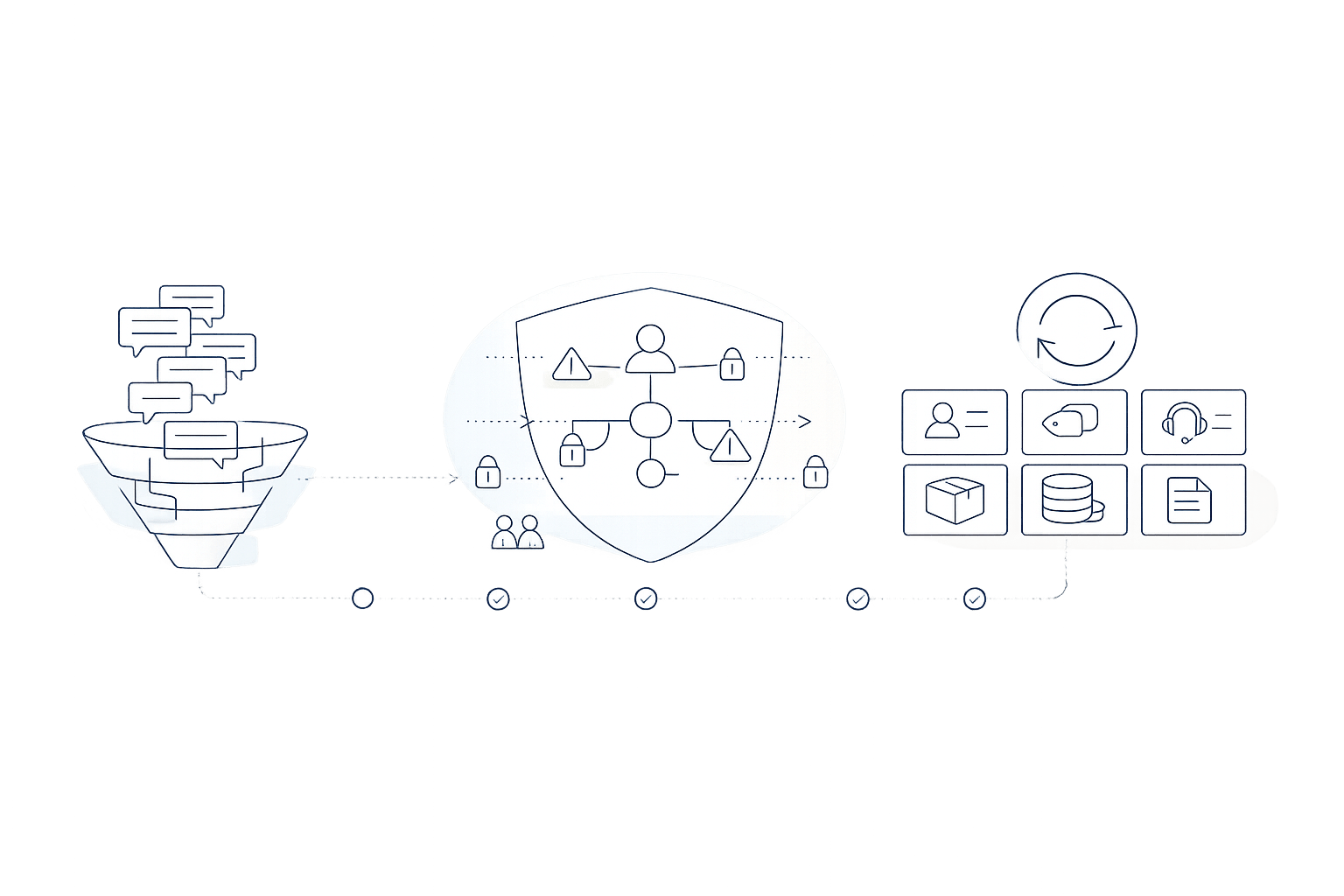
Turning free-form text into safe back-office actions works best as a pipeline with explicit boundaries:
- Interpretation: extract intent, entities, constraints, and confidence (e.g., “refund order 1837 if not delivered by July 18”).
- Planning: produce a proposed action plan that names systems touched, data required, side effects, and rollback strategy.
- Execution: run actions through an action gateway that enforces idempotency, authorization, and policy checks.
- Verification: confirm the post-state and send a customer-facing confirmation that matches the committed state.
This separation prevents a common failure mode: an “interpretation” step that silently turns into “execution” inside an integration script. Keep the execution surface small, typed, and audited.
Pattern 1: intent is not an action until it is grounded
Customer messages are often missing critical parameters. Before your system takes any write action, require grounding into an explicit action payload:
- Entities: customer, account, order, subscription, invoice, contract, device, site.
- Operation: refund, cancel, replace, renew, address change, credit issuance, price adjustment.
- Constraints: “if,” “unless,” “after,” “only when,” “before,” SLA dates.
- Evidence: message IDs, attachments, prior tickets, contract terms, policy snippets.
When information is missing, the safest “action” is a question. Designing the payload schema first helps. If you build internal tools or admin panels, the form layer should validate this payload at runtime, with secret-aware defaults and typed constraints; the same discipline described in schema-driven internal tool forms with runtime validation translates directly to message-triggered actions.
Pattern 2: classify actions by reversibility and blast radius
Not all CRM/ERP writes are equal. Build a classification grid and route execution differently:
- Reversible, low blast radius: add an internal note, tag a record, create a follow-up task.
- Reversible, medium blast radius: update address (with effective date), change contact owner, pause a subscription.
- Hard-to-reverse or high blast radius: issue refunds, close accounts, alter financial documents, change tax settings.
Use the classification to set thresholds for approvals, simulation requirements, and customer confirmation steps. In practice, this becomes an “action policy” layer: the same intent can execute differently depending on data sensitivity, role, and transaction size.
Pattern 3: idempotency keys for every write
Omnichannel systems routinely retry: webhooks are resent, emails are forwarded, chat sessions reconnect, and agents click twice. If a “refund” can happen twice, you will eventually refund twice.
Require a stable idempotency key on each action request. Good keys combine:
- Customer identifier (account or contact)
- Target object (order/subscription/invoice ID)
- Action type (refund/cancel/replace)
- Message event ID (email Message-ID, chat event UUID)
- Normalized action payload hash (amount, currency, reason code)
Store the key and the committed result. On retries, return the stored result instead of re-executing. Where downstream systems support idempotency headers, pass them through; otherwise, your action gateway must enforce it.
Pattern 4: reversible changes via compensating transactions
“Rollback” in CRM/ERP is rarely a database transaction you can undo. Instead, implement compensating actions and be explicit about what “reversal” means for each operation:
- Refund: compensation may be “void refund if unsettled,” or “issue offsetting charge,” or “create finance case for manual correction.”
- Subscription cancellation: compensation could be “reinstate with same term and proration rules,” not “undelete.”
- Address change: compensation is restoring the prior address with the original effective date and leaving a note.
For each action type, define:
- Forward action (what is executed)
- Pre-state snapshot (what you capture before writing)
- Compensation action (how you reverse)
- Irreversibility conditions (e.g., settlement completed)
This pattern is essential when customers say “Do it, unless…”: you can choose to schedule, stage, or execute with a rollback path if the condition fails.
Pattern 5: two-phase commit for customer-visible outcomes
Customers experience outcomes, not system writes. A two-phase approach reduces “we did it” messages when the back-end failed:
- Phase 1 (prepare): validate policy, check permissions, simulate totals, and pre-authorize if needed.
- Phase 2 (commit): perform the write, verify the post-state, then send confirmation.
For high-impact actions, consider a “pending” state visible internally (and sometimes externally) until verification completes.
Pattern 6: audit trails that reconstruct “who decided what”
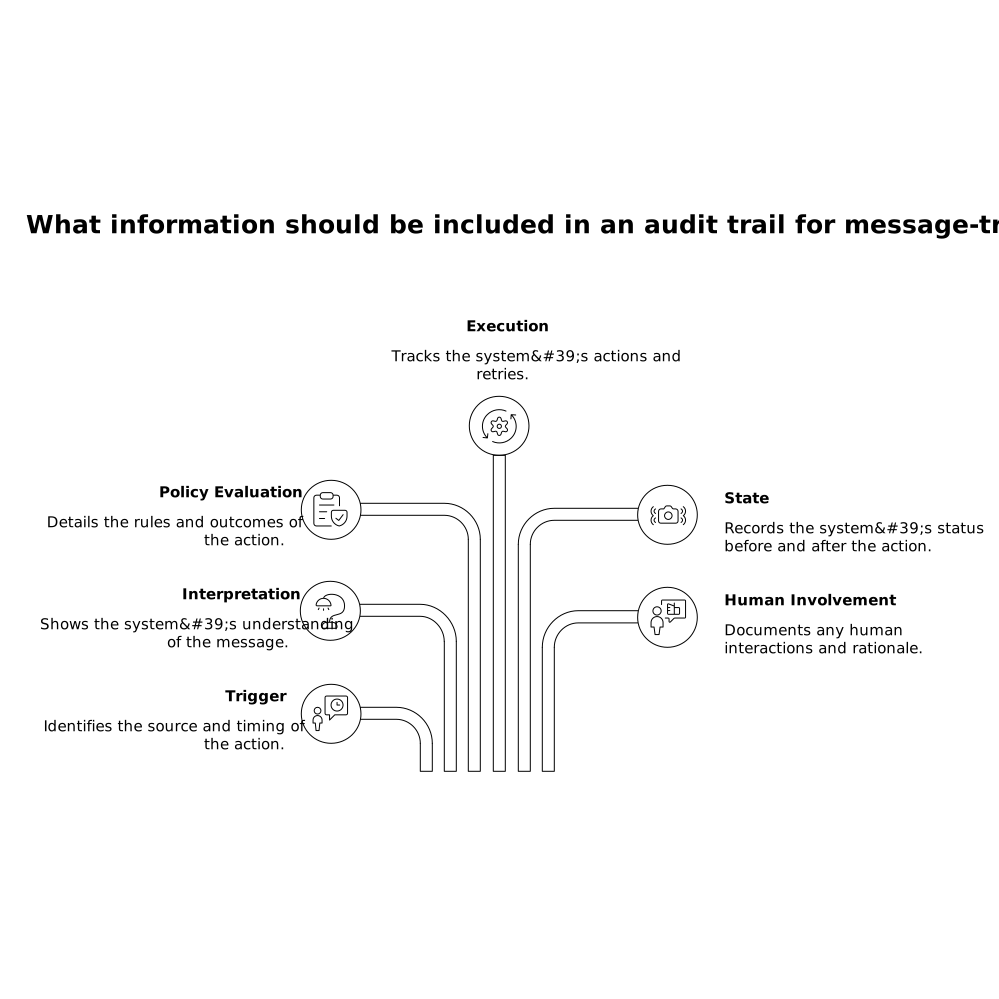
An audit trail is more than a changelog. For message-triggered actions, the minimum useful audit record includes:
- Trigger: channel, timestamp, message ID, conversation link
- Interpretation: extracted intent, confidence, alternative interpretations considered
- Policy evaluation: rules checked, outcomes, thresholds (amount limits, SLA rules)
- Execution: idempotency key, system endpoints called, correlation IDs, retries
- State: before snapshot references, after snapshot references
- Human involvement: approvals, edits, takeovers, and rationale
If you operate an AI agent layer above multiple systems, make sure the audit trail stays consistent across tools. Hybrid workflows benefit when partial resolutions, approvals, and takeovers are captured as first-class events rather than scattered notes.
Pattern 7: safe defaults for “maybe” language
Many customer messages contain uncertainty. Encode conservative defaults:
- Conditionals: convert “if X” into a scheduled check or a human approval gate.
- Ambiguous references: if multiple orders match, ask a clarifying question instead of guessing.
- Policy-sensitive requests: prefer a draft plan with a customer confirmation step (amount, address, renewal term).
A useful operational rule is: if the customer’s message could be interpreted in two materially different ways, treat it as non-executable until clarified.
Pattern 8: simulation and preflight checks before production changes
Preflight checks reduce irreversible mistakes. Examples:
- Refund preflight: delivery status, return eligibility, payment settlement, fraud signals.
- Renewal preflight: contract terms, discount validity, customer segment constraints.
- Data change preflight: downstream dependencies (shipping cutoff, invoicing schedule).
Where possible, run simulations on historical data or sandbox environments and promote changes only after automated evaluations pass. This is particularly important when business teams update behavior through natural-language instructions; changes should be validated before going live.
How this looks in practice with an AI agent layer
In a modern CX stack, you can place an AI-native orchestration layer above CRM/ERP/billing to unify policy checks, approvals, and action execution. The practical advantage is consistency: the same idempotency and rollback patterns can apply across email, chat, WhatsApp, and SMS, while still giving humans control when needed. Platforms like typewise.app are designed around this “read and write across systems” reality, including multi-agent workflows and approval-based handoffs, which map neatly to the patterns above.
The goal is not to automate everything. It is to ensure that when you do automate, the system behaves like a careful operator: deliberate, reversible when possible, and fully accountable.