Why “amenities snippets” matter for AI Overviews and rich results
Hotel and restaurant service pages often bury the details that guests actually search for: parking rules, pet policies, pool hours, Wi‑Fi quality, accessibility notes, dress codes, private dining options, or whether a venue can handle dietary restrictions. Search engines and AI systems can only surface what they can confidently extract. The “Amenities Snippet” strategy is a way to structure those service pages so amenities are easy for people to scan and easy for machines to interpret—without rewriting your site from scratch.
The core idea is simple: add a compact, standardized block of amenity information to the pages you already have, using consistent headings, concise copy, and (where appropriate) schema markup. Done well, this supports eligibility for rich results and increases the odds that your most relevant details get pulled into AI-generated answers.
What an amenities snippet is and where it belongs
An amenities snippet is a short, repeatable section on a hotel or restaurant page that answers high-intent questions in a predictable format. It’s not a new page, and it’s not a long editorial rewrite. It’s a structured module that can be added to:
- Hotel “Amenities,” “Rooms,” “Resort,” “Meetings,” and “Weddings” pages
- Restaurant “Private Dining,” “Catering,” “Reservations,” and “Menu” support pages
- Location pages for multi-property groups
Placement matters. Put it high enough that users see it quickly, but not above the primary conversion section (booking or reservation CTAs). In practice, it often works best after the first descriptive block and before long galleries, embedded maps, or lengthy policy text.
How to structure the snippet so it’s extractable
Use a consistent heading and predictable sub-sections
Consistency across pages helps both users and crawlers. Use the same heading label and the same order of sub-sections on every relevant page. For example:
- Amenities at a glance
- Policies
- Accessibility
- Parking and transportation
- Connectivity
For restaurants, you might swap “Connectivity” for “Dietary options” or “Group dining.” The key is to avoid inventing a different structure on each page.
Write in short, unambiguous statements
AI systems prefer clean claims over flowery descriptions. Instead of “We offer plenty of parking,” use “Self-parking available on-site (paid). Valet available (hours vary).” Avoid burying qualifiers in long paragraphs; keep each line atomic, with the most important detail first.
Use lists and tables sparingly, but intentionally
Amenities are naturally list-friendly. An unordered list works well for most items. If you have variations (e.g., different parking rates by season or different pool hours by day), a small table can be useful—but don’t overcomplicate it. If a detail changes frequently, summarize the rule and point to a policy page for the latest specifics.
Amenities snippet templates for hospitality pages
Hotel template example
Use this as a structural model (adjust content to match what’s truly offered):
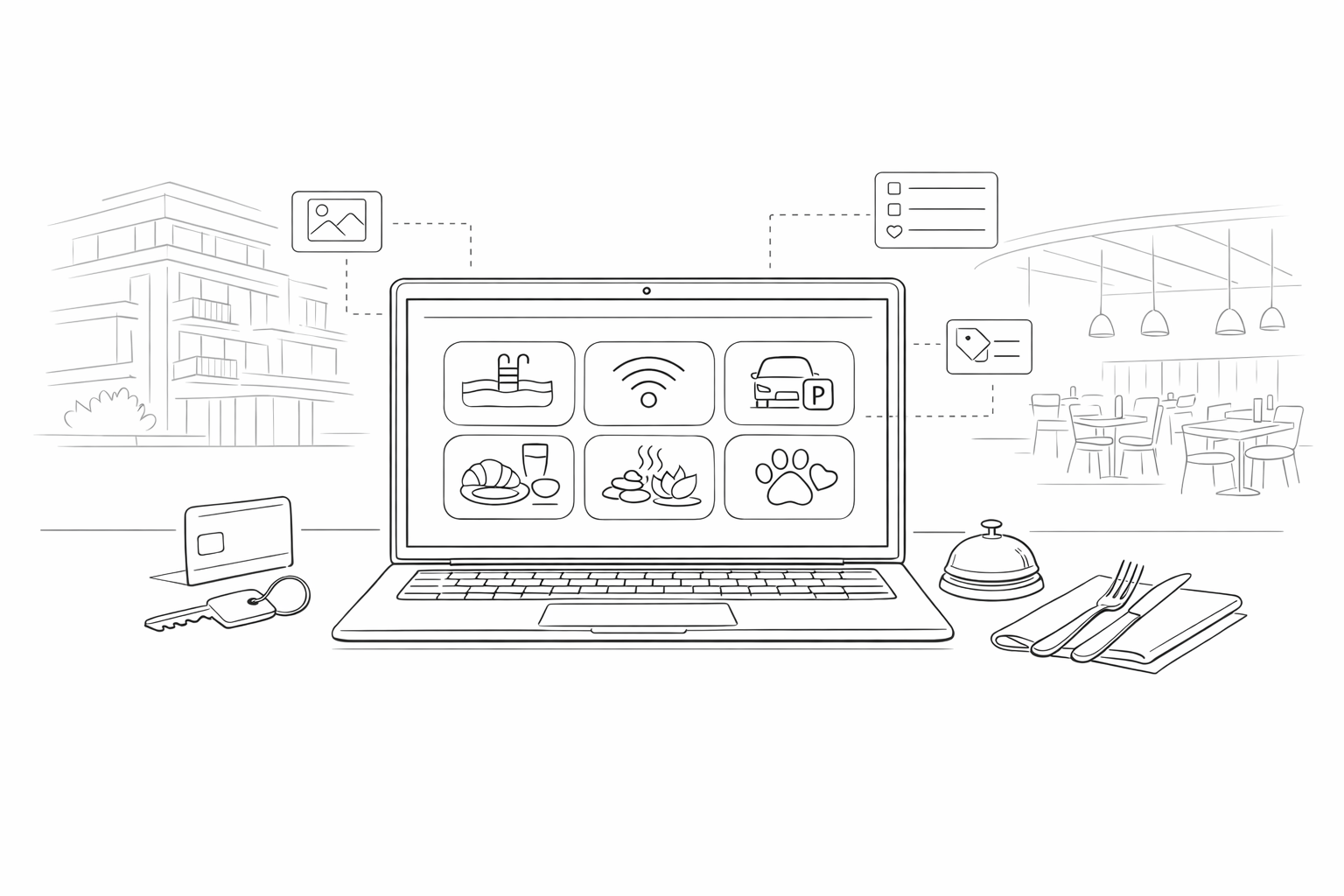
- Check-in/out: Check-in 4:00 PM; check-out 11:00 AM
- Wi‑Fi: Complimentary Wi‑Fi in rooms and public areas
- Parking: On-site self-parking (paid); EV charging (limited availability)
- Pool: Outdoor pool; towels provided; seasonal hours
- Pet policy: Pet-friendly rooms available; fees and restrictions apply
- Accessibility: Accessible entrances and rooms available; contact for specific needs
Notice how each line is clear, scannable, and avoids marketing language. This increases the chance that specific items (like EV charging or pet rules) are pulled into AI responses.
Restaurant template example
- Reservations: Accepted online and by phone
- Dress code: Smart casual
- Dietary needs: Vegetarian and gluten-aware options; ask your server
- Private dining: Semi-private space available; minimums apply
- Parking: Nearby garage parking; limited street parking
- Accessibility: Step-free entry available; accessible restroom
Schema markup that supports the strategy
The snippet itself helps readability, but structured data helps search engines interpret your claims with fewer assumptions. The goal isn’t to “game” results; it’s to reduce ambiguity.
Common schema types for hospitality include:
- Hotel or LodgingBusiness for hotel entities
- Restaurant for dining venues
- LocalBusiness as a fallback when needed
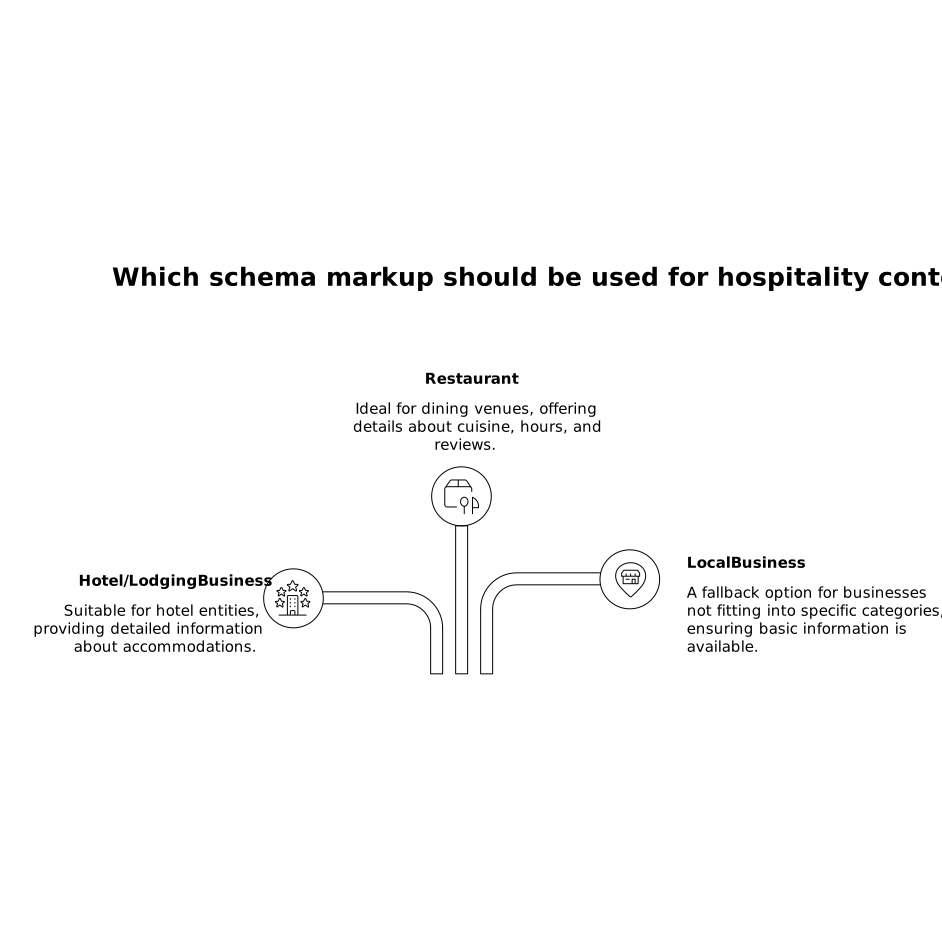
Within those, you can often represent amenities via properties such as amenityFeature (using LocationFeatureSpecification) and operational details like openingHoursSpecification for restaurants. If you don’t have clean data internally, start with what you can keep accurate—then expand.
Important: schema must match visible on-page content. If your snippet says “EV charging available,” the entity markup should not contradict it.
How to implement without rewriting your site
Step 1: Pick the pages that win (and the pages that leak)
Start with high-intent pages that already attract organic traffic or sit close to conversions: “Amenities,” “Private Dining,” “Catering,” “Rooms,” and key location pages. If you’re unsure where to start, prioritize pages that rank but underperform in click-through rate—often a sign that the page isn’t answering the query fast enough.
Step 2: Build one snippet module and reuse it
Create a single module in your CMS (or a reusable block) so the layout and headings remain consistent. The content should be configurable per location/property, but the structure should stay fixed. This is what keeps the rollout lightweight.
Step 3: Align the snippet with your real-world policies
Hospitality details change: seasonal pool hours, parking partners, pet fees, reservation platforms. Assign ownership internally so updates don’t stall. If you operate multiple properties, treat amenities as a dataset—one source of truth feeding both the page snippet and structured data.
Step 4: Connect it to supporting content only when helpful
If you already have detailed policy pages (parking, pets, accessibility, or private dining minimums), link to them. If you don’t, don’t force it—keep the snippet self-sufficient and add a single “Details” link only where the nuance matters.
Where KiksMedia fits into a hospitality-first implementation
Implementing an amenities snippet strategy touches UX, content structure, and technical SEO. For hospitality brands that want this done cleanly—without breaking existing templates—KiksMedia brings both marketing and tourism experience, which helps when translating real guest questions into page modules that remain accurate. You can explore their approach and services at kiksmedia.com.
The practical advantage is coordination: consistent page patterns, accurate amenity statements, and schema that reflects what guests actually see—so your site is better positioned for rich results and AI-driven summaries.