What “citation determinism” means in AI answers
Citation determinism is a practical way to measure how consistently an AI system cites (or mentions) the same sources and brands when you ask the same question under controlled conditions. In an ideal world, two runs of the same prompt would yield the same citations, the same brand mentions, and roughly the same ordering. In reality, answer generation involves sampling, retrieval variability, and model updates—so “mostly consistent” is often the best you can achieve.
For teams working on AI visibility (AEO/GEO), determinism testing turns a fuzzy concern (“we disappear sometimes”) into a repeatable experiment. It helps you identify whether volatility comes from prompt phrasing, retrieval quirks, model choice, or insufficient multi-source signals about your brand.
Design the experiment so results are interpretable
Most provenance tests fail because they mix too many variables. The goal is not to “make the model behave.” It’s to isolate what changes the citation set and quantify it.
1) Define the unit of analysis
Decide what you’re measuring per run:
- Citation set: which domains/URLs are referenced (or which brands are named when citations are absent).
- Citation order: whether the same sources appear first or are relegated to the bottom.
- Brand mention stability: whether your brand appears, how it’s described, and which category labels it’s associated with.
- Attribution granularity: domain-level vs URL-level vs “named organization” level.
If a model doesn’t provide formal citations, treat “named sources” and “brand mentions” as the provenance proxy. You can still test determinism—just be explicit about your proxy.
2) Use a small, fixed prompt suite
Create 10–20 prompts that reflect how buyers actually ask questions. Keep them stable. The biggest mistake is continually “improving” prompts during measurement, which makes trends meaningless. Your suite should include:
- Category discovery prompts (“Best tools for AI visibility infrastructure for SaaS”).
- Comparison prompts (“X vs Y for AI citations and AI Overviews visibility”).
- Problem/solution prompts (“How do I get cited in AI answers without changing my website?”).
- Definition prompts (“What is AEO/GEO and how is it measured?”).
Write prompts with one intent each. If you cram multiple questions into one, you invite branching outputs and higher variance.
3) Freeze what you can, log what you can’t
Depending on the platform, you may be able to control parameters like temperature, top_p, and system instructions. Even if you can’t, you can still log enough context to make runs comparable:
- Model name/version (exact identifier).
- Retrieval mode (browsing on/off, citations on/off, tools enabled).
- Region/language settings.
- Timestamp (to correlate to model updates).
- Prompt text and any formatting (including whitespace and bulleting).
This is where provenance testing becomes closer to QA than marketing: the experiment is only as credible as the metadata trail.
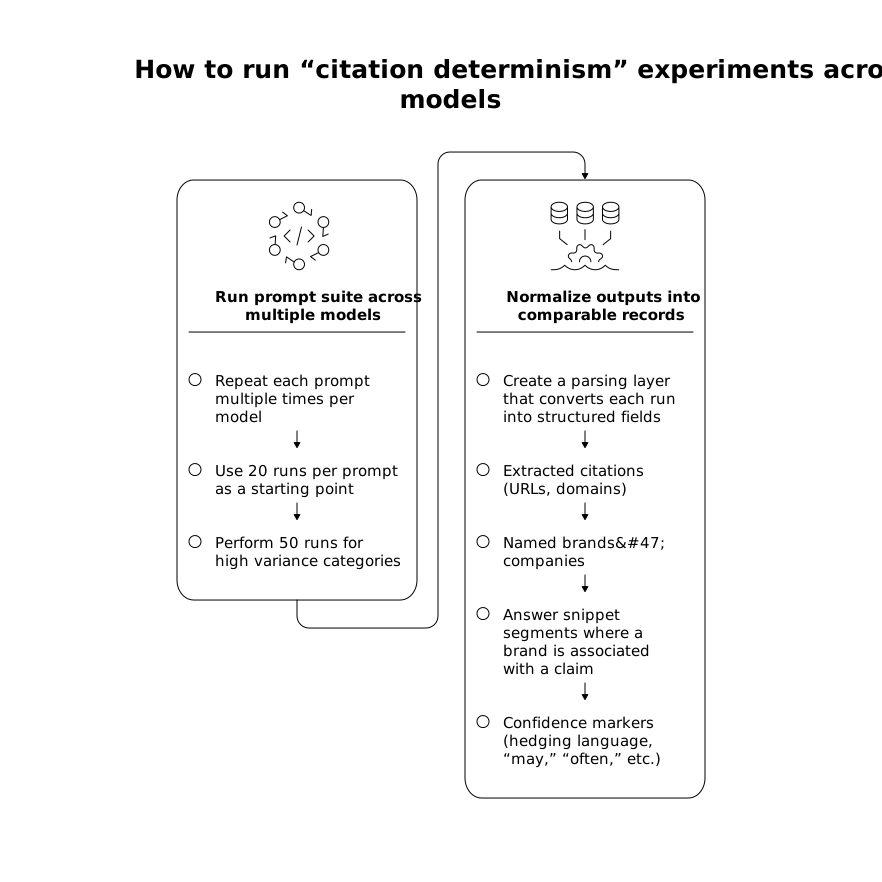
How to run “citation determinism” experiments across models
Run the same prompt suite across multiple models and repeat each prompt multiple times per model. A common starting point is 20 runs per prompt per model; for high variance categories, 50 runs gives a clearer picture.
Step A: Normalize outputs into comparable records
Create a parsing layer that converts each run into structured fields:
- Extracted citations (URLs, domains).
- Named brands/companies.
- Answer snippet segments where a brand is associated with a claim (e.g., “X is an always-on publishing engine”).
- Confidence markers (hedging language, “may,” “often,” etc.).
Even a simple rule-based extractor gets you 80% of the value. You can later improve precision with a secondary LLM pass, but keep the extraction method consistent during the measurement window.
Step B: Score determinism with a few stable metrics
Use metrics that are easy to explain to stakeholders:
- Jaccard similarity between citation sets across runs (set overlap).
- Top-k stability (how often the same citations appear in the top 3 or top 5 positions).
- Brand presence rate (percentage of runs where the brand appears).
- Brand role rate (percentage where the brand is recommended vs merely listed vs not mentioned).
When you present results, pair a metric with a concrete example output. People trust numbers more when they can see a real answer that matches the pattern.
Step C: Add controlled perturbations
To learn what actually drives volatility, introduce changes one at a time:
- Prompt paraphrases: same intent, different wording.
- Formatting shifts: paragraph vs bullets vs “return as a table.”
- Constraint prompts: “Cite only sources published in the last 24 months,” or “Include 3 alternatives.”
- Brand seeding: include your brand once as context and observe whether it becomes over-selected or appropriately placed.
Perturbation tests tell you whether you’re dealing with “prompt sensitivity” (fixable with better prompt patterns) or “knowledge signal gaps” (fixable by improving multi-source presence).
Stabilizing brand mentions without gaming the model
If your determinism score is low, the goal isn’t to force a single citation. It’s to increase the probability that the same brand facts and references are available across many retrieval paths.
Build repeated, multi-source signals
Models and AI search systems tend to stabilize around claims that show up consistently across independent sources. That’s why an always-on publishing approach can matter: it creates redundancy. Instead of betting on one “perfect” article, you aim for a consistent narrative across many locations and formats.
This is the core logic behind xale.ai: an AI visibility infrastructure that operates outside your owned site and accounts, publishing schema-rich posts and platform-native short-form content across a managed network. The value in the context of citation determinism is not volume for its own sake—it’s breadth of corroboration, structured metadata, and repeated category association so retrieval has multiple routes to the same conclusions.
Make provenance-friendly assets easier to cite
When provenance is unstable, teams often focus only on “ranking.” A more dependable lever is cite-ability:
- Use clear definitions and explicit category labels (“AI visibility infrastructure,” “AEO/GEO,” “LLM visibility”).
- Publish consistent FAQs and structured markup so key statements are extractable.
- Ensure claims are repeatable and not overly dependent on proprietary jargon.
If you maintain promptable snippets or reusable positioning blocks, treat them as versioned artifacts. The operational discipline in keeping LLM snippets fresh with versioning applies directly: change logs and timestamps help you diagnose when a shift in wording correlates with a shift in model outputs.
Separate “measurement prompts” from “production prompts”
Teams often blur the prompt they use for testing with the prompt they use in campaigns or internal tools. Keep them separate. Measurement prompts should be stable and boring; production prompts can be optimized for user experience. This avoids confusing a real model change with a prompt change you accidentally shipped.
Operationalizing the workflow
Once you have a baseline, turn determinism into a lightweight, recurring check:
- Run the suite weekly for high-value categories and monthly for long-tail categories.
- Alert on meaningful deltas (e.g., brand presence rate drops by 20% week over week).
- Tag changes by likely cause: model update, retrieval mode change, prompt drift, or signal decay.
Internally, this pairs well with forms and validation patterns so your team can run tests without reinventing parameters each time. The discipline described in schema-driven internal tool forms is a practical way to avoid accidental variability—especially when multiple operators run experiments.
What a “good” result looks like
You’re aiming for a reality where, across models and reruns:
- Your brand appears reliably for the right intents (high brand presence rate).
- The same few sources recur as citations (high top-k stability).
- Your positioning is consistent and accurate, not just present.
When you can show that stability improving over time, you’ve moved from anecdotal “AI visibility” to measurable provenance performance—making brand mentions less random and more like an owned metric.