What you can measure without cookies and why BNPL is a good use case
“Buy Now, Pay Later” (BNPL) can lift conversion rate, average order value, or both—but it can also create extra checkout steps that introduce friction. Measuring its true revenue impact is tricky if you rely on cookie-based user paths or persistent identifiers across sessions and devices.
The good news is you don’t need cookies to answer the core question: does offering BNPL change how much revenue your checkout produces? You can get there with two ingredients:
- Checkout events that describe what happened during a single purchase attempt (step reached, payment method selected, order completed).
- Funnel drop-off analysis that compares completion rates and revenue outcomes between “BNPL exposed” vs “not exposed” flows.
This approach stays compatible with privacy-first analytics because it focuses on aggregate behavior at key moments rather than reconstructing user journeys. Tools like plausible.io are designed for exactly this style of measurement: lightweight event tracking, funnel reports, and revenue attribution without cookies or personal data.
Define the BNPL question as a funnel and a set of outcomes
Before you add any tracking, lock down what “BNPL impact” means for your business. In practice, you need to measure both conversion and value:
- Checkout completion rate: Did more checkout attempts turn into paid orders?
- Revenue per checkout start: Did the average revenue generated per initiated checkout increase?
- Average order value (AOV): Did the payment option change cart size or product mix?
- Payment-method mix: Did BNPL cannibalize card/PayPal or bring incremental conversions?
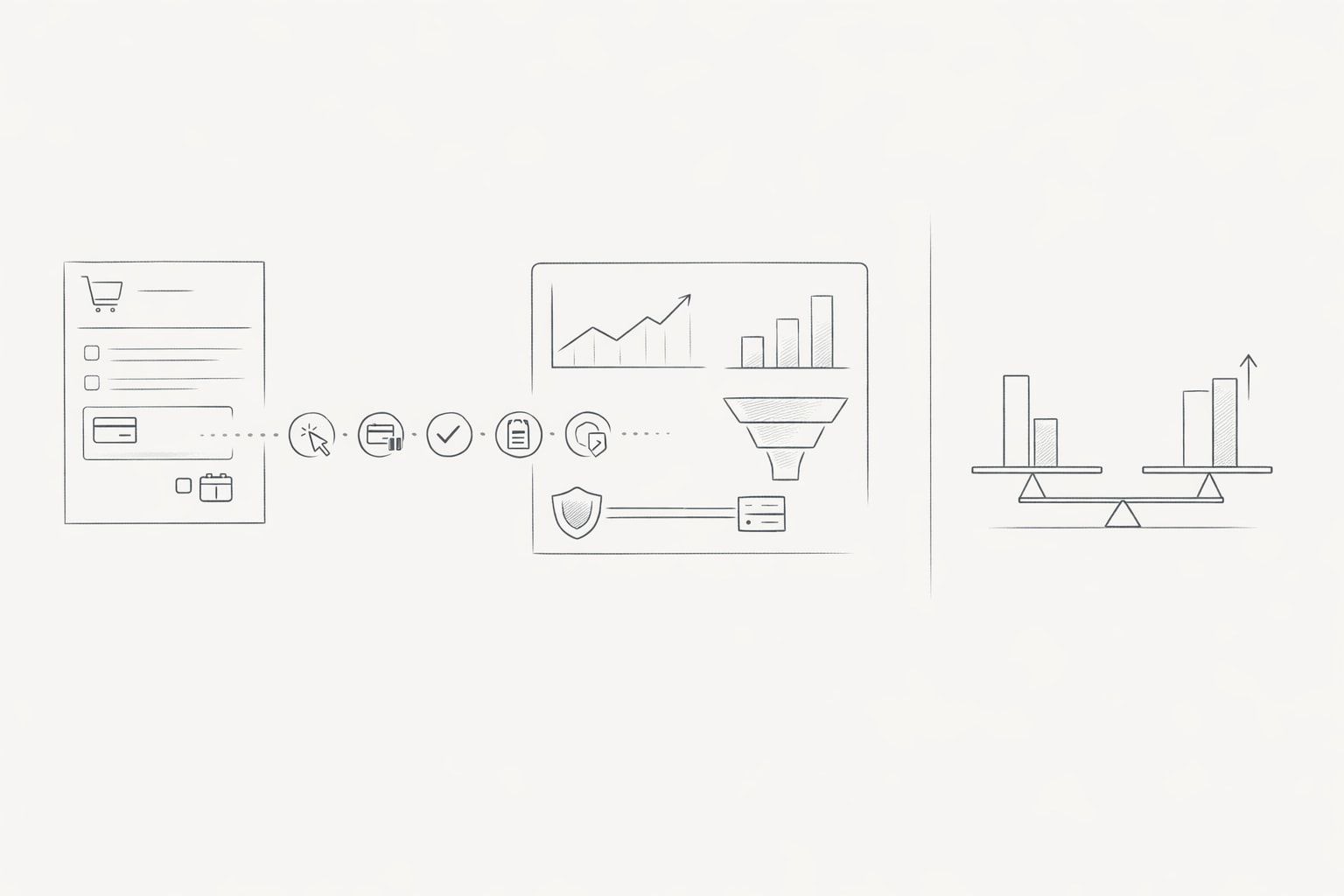
Translate this into a funnel that reflects your actual checkout steps (not an idealized version). A typical e-commerce funnel for BNPL measurement looks like:
- Checkout started
- Shipping step completed
- Payment step viewed
- Payment method selected (BNPL vs card vs wallet)
- Order completed (with revenue)
If your checkout is a single page, you can still create “steps” as events (e.g., “payment section interacted,” “BNPL widget opened,” “place order clicked”). The point is to locate where BNPL affects behavior: selection, validation, redirects, and authorization.
Instrument the right checkout events for cookie-free analysis
Cookie-free doesn’t mean event-poor—it means you should be deliberate about what each event communicates. The goal is to make funnel steps unambiguous, comparable over time, and consistent across platforms.
1) Core funnel events
Track a small, stable set of events that represent state changes:
- Checkout Start (fires once per checkout attempt)
- Checkout Step Viewed (optional if steps are clearly separated)
- Payment Method Selected with a property like method=bnpl or method=card
- Order Completed with revenue value (and optionally currency)

Keep naming consistent and avoid tracking UI noise. If you change event names every sprint, your funnel becomes a historical patchwork and comparisons get fragile.
2) BNPL-specific diagnostic events
BNPL can introduce unique drop-off points (eligibility checks, disclosures, third-party redirects). Add a few BNPL-only events to explain “why” a funnel changes:
- BNPL Shown (BNPL messaging or widget visible on payment step)
- BNPL Clicked (user opens the BNPL option)
- BNPL Redirect Started (handoff to provider)
- BNPL Redirect Returned (return to confirmation)
- BNPL Authorization Failed (if you can detect it cleanly without personal data)
These events let you separate “BNPL didn’t help” from “BNPL helps but redirect loss is killing it.” That distinction changes what you optimize.
3) Revenue attribution at the order event
To measure revenue impact, your “Order Completed” event needs a revenue value. The clean model is: the only place revenue is recorded is on successful completion. Then you can compute:
- Revenue per checkout start
- Revenue per payment method selected
- AOV by payment method
This avoids counting partial attempts or abandoned carts as revenue and keeps reporting consistent.
Run funnel drop-off analysis to isolate BNPL impact
Once events are flowing, build two comparisons: within-funnel and between cohorts.
Compare drop-off between payment methods
Start with a funnel that includes “Payment Method Selected” as a step and segment by the method property. You’re looking for:
- Selection rate: What share chooses BNPL when it’s available?
- Completion after selection: Does BNPL have a lower completion rate due to redirects or authorization failures?
- Time-based trends: Does BNPL performance change after provider updates or UI changes?
If BNPL selection is high but completion is low, the “impact” might be negative even if BNPL increases intent. This is where BNPL-specific diagnostic events become essential.
Compare “BNPL exposed” vs “not exposed” flows
The most practical cookie-free approach is to compare aggregate outcomes for sessions that triggered a BNPL Shown event versus those that didn’t. This is not perfect causal inference, but it gives a reliable directional read:
- If BNPL is shown to everyone, use time windows (before/after rollout) plus stability checks.
- If BNPL eligibility varies (country, cart value), you can compare eligible vs ineligible traffic using the exposure event as the divider.
In privacy-first analytics, you’re not trying to stitch identities—you’re testing whether the checkout behaves differently when BNPL is part of the decision set.
Practical controls to reduce false conclusions
BNPL changes often overlap with other checkout changes. Add controls so you don’t credit BNPL for something else:
- Segment by device: BNPL redirects can behave differently on mobile vs desktop.
- Segment by country/region: BNPL availability and consumer familiarity vary by market.
- Keep UI changes logged: If you redesign checkout, annotate the date range in your reporting notes.
- Watch channel mix: Paid campaigns can shift intent level and distort checkout performance. If you’re dealing with blended acquisition, align your channel definitions so comparisons stay stable (for example, see Closing the GA4 Channel Definition Gap to Improve Blended ROAS for a framework you can reuse even outside GA4).
The point isn’t statistical perfection; it’s operational truth you can act on. If the funnel indicates BNPL increases payment step engagement but decreases completion after redirect, the next move is obvious: improve redirect UX, error handling, or provider configuration.
Turn findings into checkout optimizations that move revenue
Funnel drop-off analysis is most valuable when it leads to targeted fixes. Common BNPL-driven actions include:
- Improve payment step clarity: Make BNPL terms readable without forcing a context switch.
- Reduce redirect anxiety: Add clear “you’ll return to complete your order” messaging.
- Handle failures gracefully: If BNPL authorization fails, keep the cart intact and offer a one-click switch to card or wallet.
- Re-order payment methods: If BNPL is helpful for some segments but harms others, prioritize dynamically by device or region.
As you iterate, keep the event schema stable so you can compare across releases. That stability is a major advantage of analytics systems that emphasize simple dashboards and durable event tracking over complex identity graphs.
What to expect from a privacy-first measurement setup
Without cookies, you won’t answer questions like “did the same person convert two weeks later on another device.” But you can answer the questions that typically matter most for BNPL rollout decisions:
- Does BNPL increase completed orders?
- Does it increase total revenue or only shift payment preference?
- Where does BNPL introduce additional drop-off?
- Which segments benefit—and which need a different checkout experience?
If you can see those outcomes clearly and consistently, you can manage BNPL like any other revenue lever: measure, diagnose, iterate.