
The cliff between warmup and campaign outreach
Email warmup and real outreach look similar on the surface: messages go out, replies come back, and your inbox placement improves. The problem is that mailbox providers don’t score “email” as one activity. They score patterns.
The “warmup-to-campaign cliff” happens when a sender spends days or weeks generating friendly engagement signals (opens, short replies, clean reading behavior), then suddenly switches to higher-volume, colder, more template-like outreach. That change in pattern can make previously healthy inbox placement fall fast—sometimes within a day—because the new traffic looks unlike the reputation you just built.
The fix is not simply “warm up longer.” It’s staging a transition so the reputation you’ve earned remains believable when the outreach begins.
Why engagement emails behave differently than outreach
Warmup engagement is low-risk by design
Warmup systems intentionally create positive signals: consistent sends, steady opens, quick reads, replies, and “not spam” actions. Many warmup messages are short, conversational, and sent between addresses that reliably interact. That’s useful for establishing baseline trust, but it can also create a narrow behavioral fingerprint.
Campaign outreach introduces new risk signals
Cold or semi-cold outreach typically changes multiple variables at once:
- Recipient quality shifts (new contacts, less prior relationship, more indifference).
- Message similarity rises (templates, repeated phrasing, repeated links).
- Negative outcomes increase (no opens, quick deletes, spam complaints, bounces).
- Volume tends to spike (because campaigns are scheduled, not organic).
To providers, that combination can look like “a new sender suddenly started behaving like a bulk marketer,” even if your warmup looked great the day before.
What “tanking inboxing” looks like in practice
The cliff rarely shows up as a gentle decline. It’s more often a discontinuity:
- Gmail moves you from Primary to Promotions, then to Spam for a portion of recipients.
- Microsoft 365/Outlook starts filtering aggressively or throttling delivery.
- Yahoo becomes inconsistent: some sends land well, others disappear into spam without obvious reasons.
In logs, you’ll see more deferrals and more unexplained variance. In campaign metrics, you’ll see “suddenly nobody is opening,” which is often an inbox placement issue rather than a targeting issue.
The mechanics behind the cliff
Reputation is contextual, not just cumulative
Sender reputation builds over time, but it is evaluated in context: who you’re emailing, what the content resembles, how recipients behave, and whether volume changes look natural. A warmup phase that produces uniform engagement can accidentally train a narrow baseline that your campaign immediately violates.
Volume shocks amplify every other issue
If you change volume and content and audience in the same week, you lose the ability to diagnose what caused the drop. Worse, the provider sees a pattern change that resembles compromised accounts and newly activated bulk-sending infrastructure.
Engagement signals don’t transfer 1:1
A warmup open and reply is valuable, but it’s not a guarantee for outreach. Warmup is about proving you can send mail that recipients want. Outreach is about proving you can do that at scale to recipients who didn’t ask for it. Those are different tests.
How to stage a smooth ramp from warmup to outreach
1) Freeze variables and ramp one dimension at a time
Plan a transition period where you only change one of these at once: volume, audience novelty, or content similarity. The simplest pattern is:
- Week 1: keep volume modest, introduce the first slice of real prospects, keep copy highly individualized.
- Week 2: increase volume slightly, expand audience, keep templates restrained and avoid repeated heavy link usage.
- Week 3: only then introduce higher automation and broader sequences.
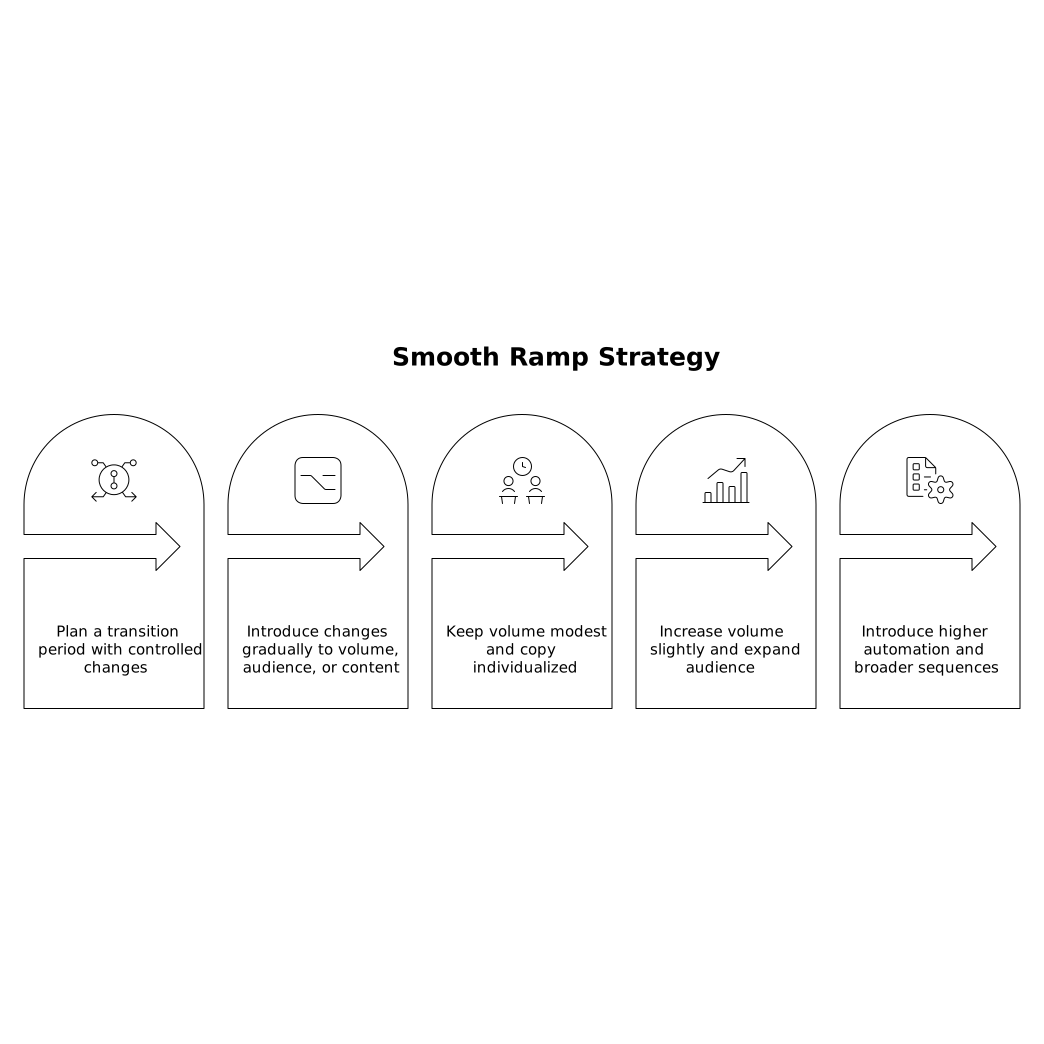
This makes your sending behavior look like a real team scaling activity rather than flipping a switch.
2) Keep warmup running while outreach starts
Don’t stop warmup on the day you launch outreach. The warmup traffic provides ongoing positive engagement that can buffer the first wave of cold sends. The key is to avoid letting warmup dominate your total volume once your campaign grows—otherwise your sender fingerprint becomes “mostly warmup.”
Platforms like mailwarm are designed to maintain steady, human-like engagement signals (opens, replies, inbox interactions, and spam recovery actions) across major providers, which is useful during this overlap period—especially when your outreach metrics are still stabilizing.
3) Start with “high-intent” segments first
To reduce early negative signals, begin outreach with recipients most likely to engage:
- Recent inbound leads
- Newsletter subscribers who opted in (even if you’re switching to a direct offer)
- Past customers or warm referrals
This isn’t about gaming metrics—it’s about proving to the inbox that your new content can still generate wanted interactions.
4) Reduce template uniformity at the start
Providers don’t “hate templates,” but uniformity plus volume plus new recipients is a classic spam pattern. During your ramp, reduce repetition:
- Use 2–4 copy variants per step, not one.
- Vary subject lines, opening lines, and call-to-action phrasing.
- Keep links minimal early on; avoid link shorteners.
- Prefer plain-text formatting until placement is stable.
As stability improves, you can standardize more.
5) Control your daily send shape
Inboxing often drops when your send pattern looks “batchy.” Even at the same total volume, a smooth curve performs better than a spike. If you send 300 emails, spreading them across the day usually looks more natural than pushing them in 10 minutes.
6) Build a monitoring loop that distinguishes deliverability from performance
When opens drop, teams often change copy, targeting, and cadence at the same time. That makes things worse. Separate questions:
- Deliverability question: Are messages reaching inboxes?
- Offer question: Are inboxed messages getting replies?
If you’re already running a structured feedback loop for product onboarding versus feature demand, the same principle applies to outreach: separate “distribution problems” from “message-market fit problems.” A useful mental model is the idea behind a two-queue feedback system, adapted to deliverability vs. copy/targeting.
A practical ramp plan you can actually run
Days 1–3: Soft launch
- Keep warmup active.
- Send small outreach volume per mailbox.
- Target warmer segments and personalize heavily.
- Track bounces, spam complaints, and placement tests.
Days 4–10: Controlled scaling
- Increase volume gradually (small daily increments).
- Add a second and third copy variant.
- Introduce links only where necessary.
- Watch for early warning signals (inbox placement variance, throttling, rising complaints).
Days 11–21: Normalization
- Expand to broader prospect lists.
- Move toward your standard sequencing, still avoiding sharp spikes.
- Keep some ongoing warmup to stabilize reputation, adjusting the ratio as outreach volume becomes the primary pattern.
Common mistakes that recreate the cliff
- Turning off warmup abruptly the same day you start a campaign.
- Doubling volume after one “good day” of opens or replies.
- Sending the same template across multiple domains/mailboxes in a short window.
- Ignoring list hygiene and letting bounces/invalids sabotage reputation early.
- Diagnosing by opens alone when inbox placement is the real issue.
Vertical Video